

Education Needs to Be Disrupted (Again)
AI is not replacing learning. It’s exposing how outdated our model of learning has become.

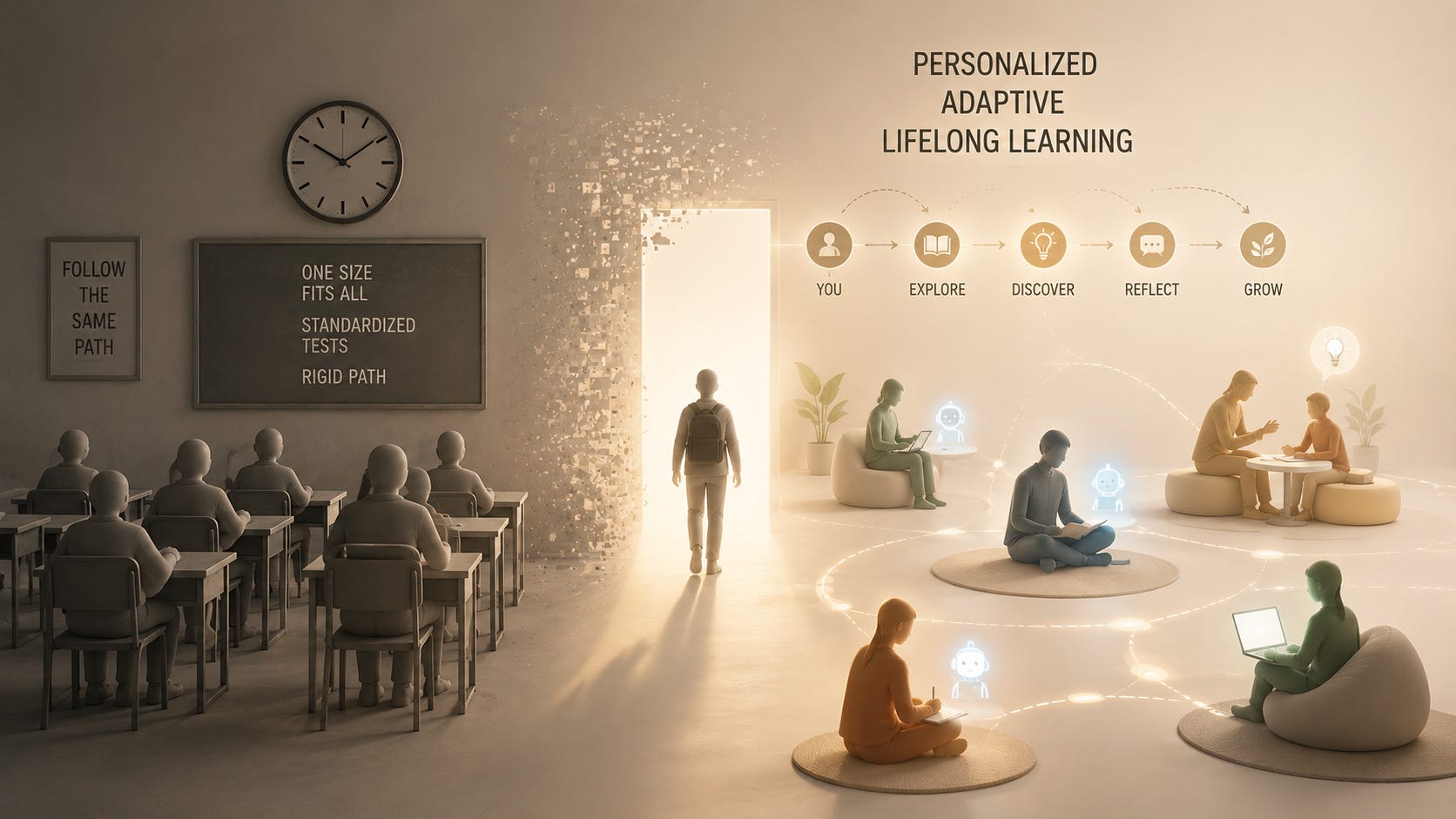
The System We Call Education Was Built for a Different Era
Education is one of those institutions that becomes nearly invisible because it is so familiar. Most of us grew up inside some version of the same structure: classrooms organized by age, standardized curricula, scheduled instructional periods, periodic testing, and a progression model that assumes everyone should move forward at roughly the same pace. Because this framework is so deeply embedded in society, it is easy to assume that this is simply what education looks like.
But it isn’t some timeless model of human learning.
It is a design response to a specific historical problem.
The modern educational system was largely built to scale instruction efficiently during an industrial era, when information was scarce, access to expertise was limited, and societies needed mechanisms to educate large populations in a reasonably consistent way. Standardization was not an accident. It was a rational operational strategy. If one teacher had to educate many students with limited tools, synchronized instruction and fixed pacing made sense.
That model worked reasonably well for the world it was designed for.
The issue is that the surrounding world changed dramatically, while much of the educational architecture remained recognizable to someone from generations ago.
This space is built for people who care about the future—not just the shiny version, but the human one. If that sounds like you, consider upgrading to a paid subscription. You’ll be helping to keep independent thinking alive and unfiltered.
We Have Been Improving Delivery Without Reimagining Learning
Education has not been static. Schools and institutions have adopted wave after wave of technological improvement. Chalkboards became digital displays. Printed assignments became online submissions. Libraries became searchable digital repositories. Video lectures expanded access. Learning platforms added structure, convenience, and analytics.
But most of these changes improved the delivery layer rather than the learning model itself.
The core assumptions remained largely untouched. Students still move in cohorts based primarily on age. Content is still often delivered according to predetermined schedules rather than individual readiness. Assessment still frequently emphasizes procedural correctness and standardized output. Institutional time structures still dominate the experience, as though learning naturally conforms to administrative calendars.
This pattern should feel familiar.
Organizations often adopt modern tools while preserving legacy assumptions. They improve interfaces without rethinking architecture. Education has done this repeatedly, layering technology onto a model whose structural logic was shaped by constraints that no longer fully apply.
AI matters because it challenges those constraints more fundamentally than previous technologies did.
AI Changes the Economics of Personalized Learning
One of the defining limitations of traditional education has always been scarcity.
Teacher attention is scarce. Individual tutoring is scarce. Immediate feedback is scarce. Adaptive pacing is scarce. Personalized explanation is scarce.
That scarcity shaped the educational system we built.
AI begins to dismantle it.
A learner with access to a capable AI system can ask questions repeatedly without embarrassment or delay. Concepts can be explained in multiple ways until understanding emerges. Examples can be adapted to the learner’s context. Follow-up exploration can happen instantly. Someone struggling with a concept no longer needs to wait for institutional availability to receive clarification.
This is not simply a convenience upgrade.
It changes the economics of learning.
For the first time, individualized explanatory support can exist at scale without requiring proportional increases in human instructional labor. That alone should force a reevaluation of educational design assumptions that have persisted largely because personalization was historically expensive.
Once scarcity weakens, standardization becomes less defensible as the default model.
Personalization Was Always the Goal We Couldn’t Afford
The irony is that educators have long understood the importance of personalization.
Most teachers know that learners absorb information differently. Some need repetition. Some need conceptual framing. Some need visual examples. Some need practical application. Some move quickly, while others need time to build confidence.
The problem has never been awareness.
The problem has been structural feasibility.
Even exceptional teachers operate within severe constraints. Time, class size, curriculum expectations, administrative requirements, and resource limitations make true individualized instruction extraordinarily difficult.
Standardization became the institutional workaround.
AI changes that calculation.
A system capable of adapting explanations, pacing, and interaction style continuously for each learner introduces a personalization layer that has historically been inaccessible at scale. That does not automatically solve education, but it dramatically expands what becomes structurally possible.
And when structural possibility changes, institutional design should follow.
This Is Not About Replacing Teachers
The predictable public reaction to AI in education is anxiety about replacement.
Will teachers become obsolete?
That framing misunderstands what teachers actually do.
Teachers are not merely information delivery systems. They motivate reluctant learners, recognize emotional disengagement, create accountability, foster social development, contextualize knowledge, and help shape confidence and intellectual identity. Much of education is deeply human and relational.
AI may become excellent at explanation, repetition, adaptive practice generation, and immediate feedback. That does not eliminate the human role.
It changes where human effort creates the most value.
If AI handles more routine explanatory work, teachers can spend more time on mentorship, critical thinking development, emotional support, group facilitation, and helping learners build intellectual judgment. That is arguably a more valuable and distinctly human educational role.
The future of education should not be framed as teacher elimination.
It should be framed as educational role redesign.
Assessment May Be Where the Pressure Hits Hardest
One of the most disruptive effects of AI may be what it reveals about assessment.
Traditional educational evaluation often depends on outputs that AI can now produce competently: essays, summaries, structured responses, problem solutions, research synthesis, and increasingly sophisticated analytical content.
This creates institutional panic because many familiar evaluation mechanisms become less trustworthy.
But perhaps this disruption is clarifying rather than destructive.
If a student can generate acceptable outputs without deep understanding, then the assessment may have already been measuring procedural production rather than genuine learning. AI simply makes that weakness impossible to ignore.
This creates an opportunity to rethink what educational assessment should emphasize.
Reasoning under uncertainty.
Original synthesis.
Interpretation.
Verbal defense of ideas.
Applied problem-solving.
Judgment.
Collaborative thinking.
These forms of evaluation are less dependent on procedural output and more aligned with actual intellectual capability.
AI may force education toward more authentic measures of understanding.
Education Should Become a Lifelong Operating System
Another outdated assumption AI challenges is the idea that education is front-loaded.
The traditional model assumes that formal learning happens early, followed by decades of application with occasional retraining. That model reflected slower-moving economic and knowledge environments.
That world no longer exists.
Industries transform rapidly. Career paths are nonlinear. Skills expire faster. Adaptability matters more than credential permanence.
AI makes continuous adaptive learning more realistic.
A mid-career professional can explore a new field with guided support. A retiree can develop entirely new capabilities. Someone changing industries can accelerate learning without needing to re-enter rigid institutional systems immediately.
This shifts education from being a life phase to being an ongoing operating model.
That may ultimately be one of AI’s most important educational contributions.
The Greatest Risk Is Superficial Adoption
Of course, institutions may respond poorly.
History suggests this is entirely plausible.
AI could become just another surface modernization layer—another digital enhancement bolted onto an unchanged structural model. Schools may deploy AI assistants while preserving rigid pacing, weak assessment design, age-based grouping, and industrial administrative assumptions.
That would be a missed opportunity.
The real promise of AI in education is not automation for its own sake.
It is architectural pressure.
AI removes many of the constraints that justified standardization in the first place. If institutions use AI merely to preserve outdated models more efficiently, then they will have mistaken optimization for transformation.
That would be classic patch culture.
And education deserves better than another patch.
Final Thought
Education absolutely needs disruption—not because teachers have failed, and not because schools are irrelevant, but because much of the institutional structure we inherited was optimized for a world that no longer exists.
AI is not the solution to education.
But it is a catalyst.
It removes scarcity assumptions, challenges outdated assessment models, enables personalization at scale, and forces difficult questions about what learning should actually look like in a world where intelligence support is abundant.
We can use AI to preserve the existing architecture a little longer.
Or we can finally redesign education around how humans actually learn.
Only one of those options qualifies as real innovation.
This space is built for people who care about the future—not just the shiny version, but the human one. If that sounds like you, consider upgrading to a paid subscription. You’ll be helping to keep independent thinking alive and unfiltered.
AI is cool, but what if you could actually use it as your life coach?
That’s what 10xYOU is all about—turning AI into extra income, more focus, and healthier habits. It’s like thinkfuture’s practical twin—same curiosity, but built for action.
Check out our 10xYOU publications:

Money Monday with Ben Caldwell: Your AI Money Coach
Start your week with smart, stress-free money moves. Every Monday, Ben shares one actionable way to use AI to save, earn, or invest better. No fluff, no jargon—just practical steps you can use right away to make your money work harder for you.
Workflow Wednesday with Nik Harper: Your AI Productivity Coach
Every Wednesday, Nik shows you how to work smarter, not harder. From AI-powered tricks to practical workflow shifts, she’ll help you save time, cut stress, and actually enjoy your week. Quick reads, easy experiments, real results.
Fulfilment Friday with Leo Serrano: Your AI Wellness Coach
Fridays aren’t just the end of the week—they’re a reset. In Fulfillment Friday, Leo blends espresso-fueled storytelling, Nonna’s wisdom, and AI guidance to help you recharge and find balance. Each issue delivers a personal story, practical wellness strategies, and one simple “Friday Reset” challenge you can actually use before Monday.
100% agree! AI acts as a disruptive catalyst by dismantling the necessity for mass-standardization, effectively flipping the model from delivery-centric to learner-centric.
Great article with broad applicability. Thanks for the read.