

When All Content Is Personal
Why an AI-mediated creative future is not dystopian, but inevitable

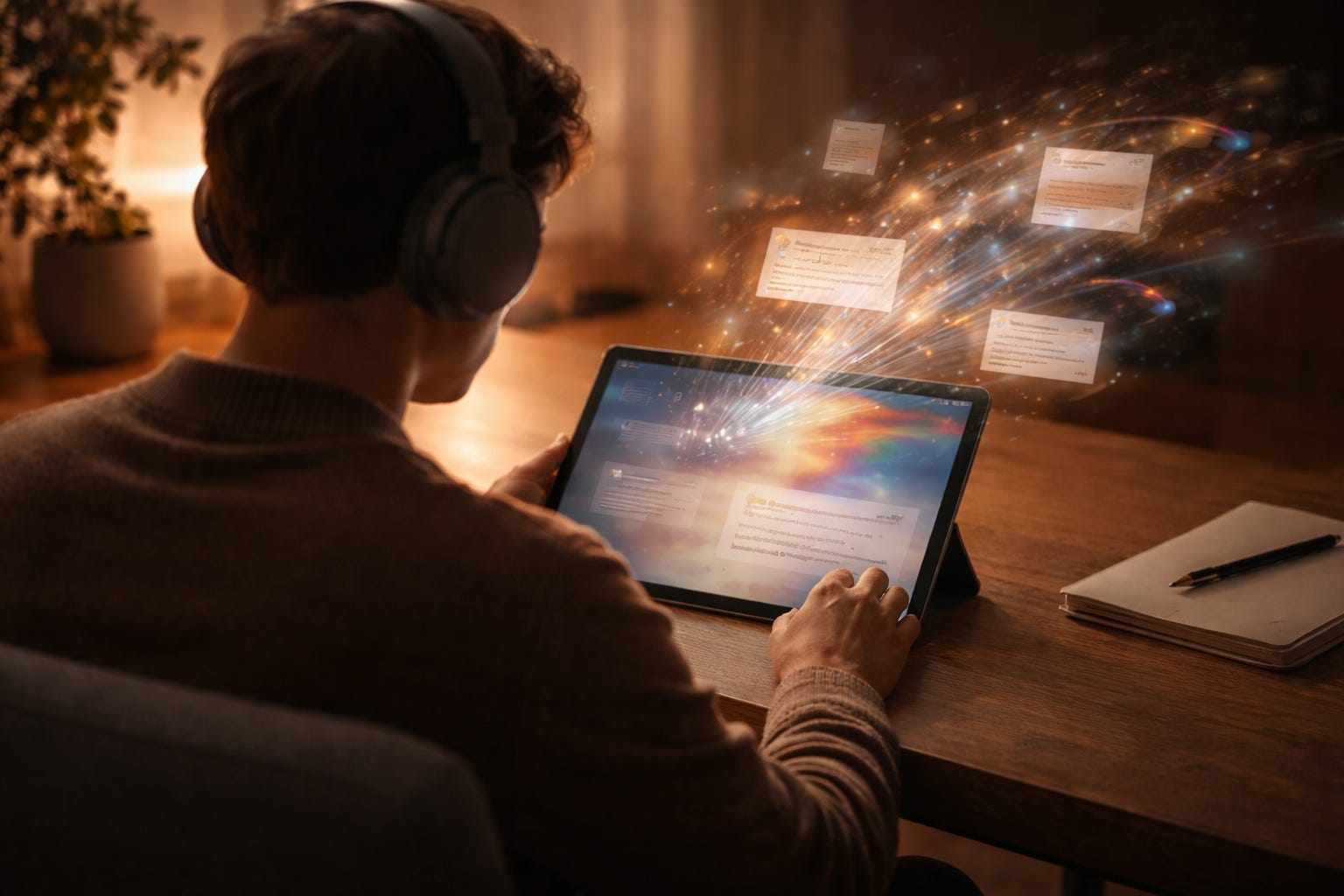
As AI becomes more sophisticated, a quiet but profound shift is underway in how content is created and consumed. We are moving beyond mass media, beyond niche media, and even beyond audience-specific media. The trajectory points toward a world where content is generated on the fly, personalized not for a demographic or a segment, but for a single individual.
You.
This is not science fiction. We are already on the path.
This space is built for people who care about the future—not just the shiny version, but the human one. If that sounds like you, consider upgrading to a paid subscription. You’ll be helping to keep independent thinking alive and unfiltered.
From Mass Media to Individual Media
Media has always followed the same pattern: from broad to narrow.
First came mass broadcast. One signal, millions of viewers.
Then came cable and segmentation. Many channels, smaller audiences.
Then came the internet. Infinite content, discoverable niches.
Then came algorithms. Feeds tuned to preferences and behavior.
The next step is not difficult to see. Once systems can reliably model an individual’s tastes, history, mood, and context, there is no reason to stop at targeting groups.
Why generate content for a million people when you can generate it for one?
We’re Already Seeing the Early Signals
AI-generated content already exists everywhere.
Music tracks optimized for specific listening contexts.
Articles summarized or rewritten for different readers.
Videos tailored to viewing habits.
Recommendations shaped by behavior rather than explicit choice.
Today, this content is still produced for audiences, even if those audiences are narrow. But the systems that power this are learning individual patterns, not just aggregate ones.
Once the cost of generation approaches zero, personalization becomes the default.
The End of “The Audience”
In a fully personalized media environment, the concept of “the audience” begins to dissolve.
There is no longer a shared feed.
No longer a common experience.
No longer a single version of a song, article, or story.
Instead, there are millions of parallel creations, each tuned to a specific person’s preferences, context, and moment in time.
Content becomes fluid rather than fixed.
AI Will Be In Every Piece of Content
On the way to this future, it’s useful to assume something simple: every piece of content will include some AI component.
Sometimes that component will be minimal.
Sometimes it will be dominant.
Sometimes it will be invisible.
The percentage does not matter as much as the reality that pure, untouched human creation will become the exception rather than the norm.
AI will sit somewhere between zero and far beyond what we currently consider “full automation,” quietly shaping creation even when humans are still involved.
Why This Is Not a Dystopia
This shift is often framed as a loss. The fear is that human creativity will be replaced, diluted, or made irrelevant.
That framing misses something important.
AI does not remove creativity. It removes barriers to creativity.
For most of human history, artistic expression has been constrained by technical skill. You could imagine a painting but not paint it. Hear music in your head but not compose it. See a film but not shoot it.
AI collapses that gap.
People who were previously excluded from creative expression due to lack of training, time, or resources will be able to create. Not by copying existing art, but by translating internal ideas into external form.
That is not a narrowing of creativity. It is an expansion.
New Art From New Minds
The most interesting consequence of AI-mediated creation is not efficiency. It is access.
When tools become expressive rather than technical, entirely new voices emerge. People with unconventional perspectives, unusual intuitions, or nontraditional backgrounds gain the ability to create in ways that were previously impossible.
The result will not be uniformity. It will be divergence.
Art does not become less human when tools improve. It becomes more reflective of the humans who can finally participate.
The Myth of “Pure” Creation
There is a tendency to romanticize art created without tools, mediation, or assistance.
But all creation has always been mediated.
Language mediates thought.
Instruments mediate music.
Cameras mediate vision.
Software mediates design.
AI is not a rupture. It is a continuation.
What changes is not that tools exist, but that tools now participate more actively in the creative process.
Authorship Will Become Fuzzier
As AI becomes part of every creative workflow, authorship becomes less binary.
Was the art created by a human or by AI?
The honest answer will often be: both.
This does not invalidate the work. It simply requires new ways of thinking about credit, originality, and contribution.
Creation has always been collaborative. We are just expanding the set of collaborators.
The Loss of Shared Culture Is Real
There is one legitimate concern in a world of fully personalized content: the erosion of shared experience.
If everyone consumes a different version of reality, common reference points weaken. Culture fragments further. Collective meaning becomes harder to sustain.
This is not trivial. It will require conscious counterbalances. Public spaces. Shared rituals. Common works that resist personalization.
But this is a social challenge, not an argument against the tools themselves.
Embracing the Reality We’re Entering
The question is no longer whether AI will be involved in content creation.
It will be.
The real question is whether we cling to an outdated idea of authorship and purity, or adapt our understanding of creativity to match reality.
Content creation is becoming hybrid. Dynamic. Personalized. Mediated.
Resisting that does not preserve creativity. It only limits participation.
A More Useful Question
Instead of asking whether AI-created or AI-assisted art “counts,” a better question is this:
Does the work express something meaningful?
Does it reflect a human perspective?
Does it provoke thought, emotion, or insight?
If the answer is yes, the toolchain matters far less than we think.
Your Personal Content Engine
A future where content is generated uniquely for each individual is not a betrayal of creativity. It is an extension of it.
AI will not replace human imagination. It will amplify it, redistribute it, and unlock it for people who were previously excluded.
Creation is changing.
Content is changing.
Authorship is changing.
The choice is not whether to stop it. That is not possible.
The choice is whether to embrace it thoughtfully and shape what this new creative world becomes.
AI is cool, but what if you could actually use it as your life coach?
That’s what 10xYOU is all about—turning AI into extra income, more focus, and healthier habits. It’s like AI Daily’s practical twin—same curiosity, but built for action.
Check out our 10xYOU publications:
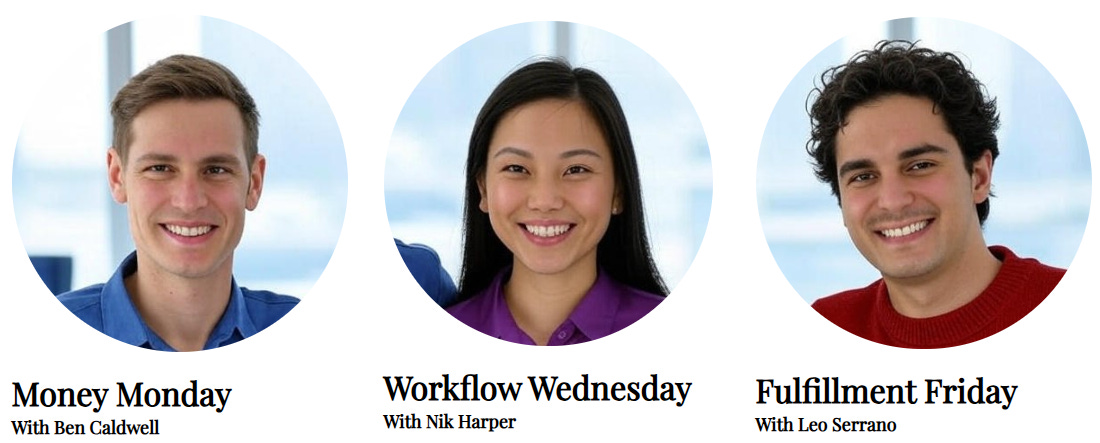
Money Monday with Ben Caldwell: Your AI Money Coach
Start your week with smart, stress-free money moves. Every Monday, Ben shares one actionable way to use AI to save, earn, or invest better. No fluff, no jargon—just practical steps you can use right away to make your money work harder for you.
Workflow Wednesday with Nik Harper: Your AI Productivity Coach
Every Wednesday, Nik shows you how to work smarter, not harder. From AI-powered tricks to practical workflow shifts, she’ll help you save time, cut stress, and actually enjoy your week. Quick reads, easy experiments, real results.
Fulfilment Friday with Leo Serrano: Your AI Wellness Coach
Fridays aren’t just the end of the week—they’re a reset. In Fulfillment Friday, Leo blends espresso-fueled storytelling, Nonna’s wisdom, and AI guidance to help you recharge and find balance. Each issue delivers a personal story, practical wellness strategies, and one simple “Friday Reset” challenge you can actually use before Monday.
While I agree AI lowers the barrier to entry, current generative AI is just an amalgamation of existing art. It doesn’t create original works, regardless of how good a Prompt Writer you are. LLM’s have been trained on millions of pieces of literature, music, videos and pieces of art. When you say it won’t be homogeneous - that’s exactly what AI does. It takes what we have already produced and parrots it back at us. Generative AI cannot, in its current form create originality.
Thirty years in sales taught me audiences aren’t real. There’s only the person in front of you, and content is finally catching up. The problem was never ideas, it was getting them out of your head.