

The Creator’s Dilemma
Between what you want to make and what the world wants from you

There’s a point every creator hits, no matter what they make.
Art. Music. Writing. Film. Apps. Code. Videos.
It’s the tension between two worlds:
One is pure—what you want to create.
The other is practical—what your audience wants to consume.
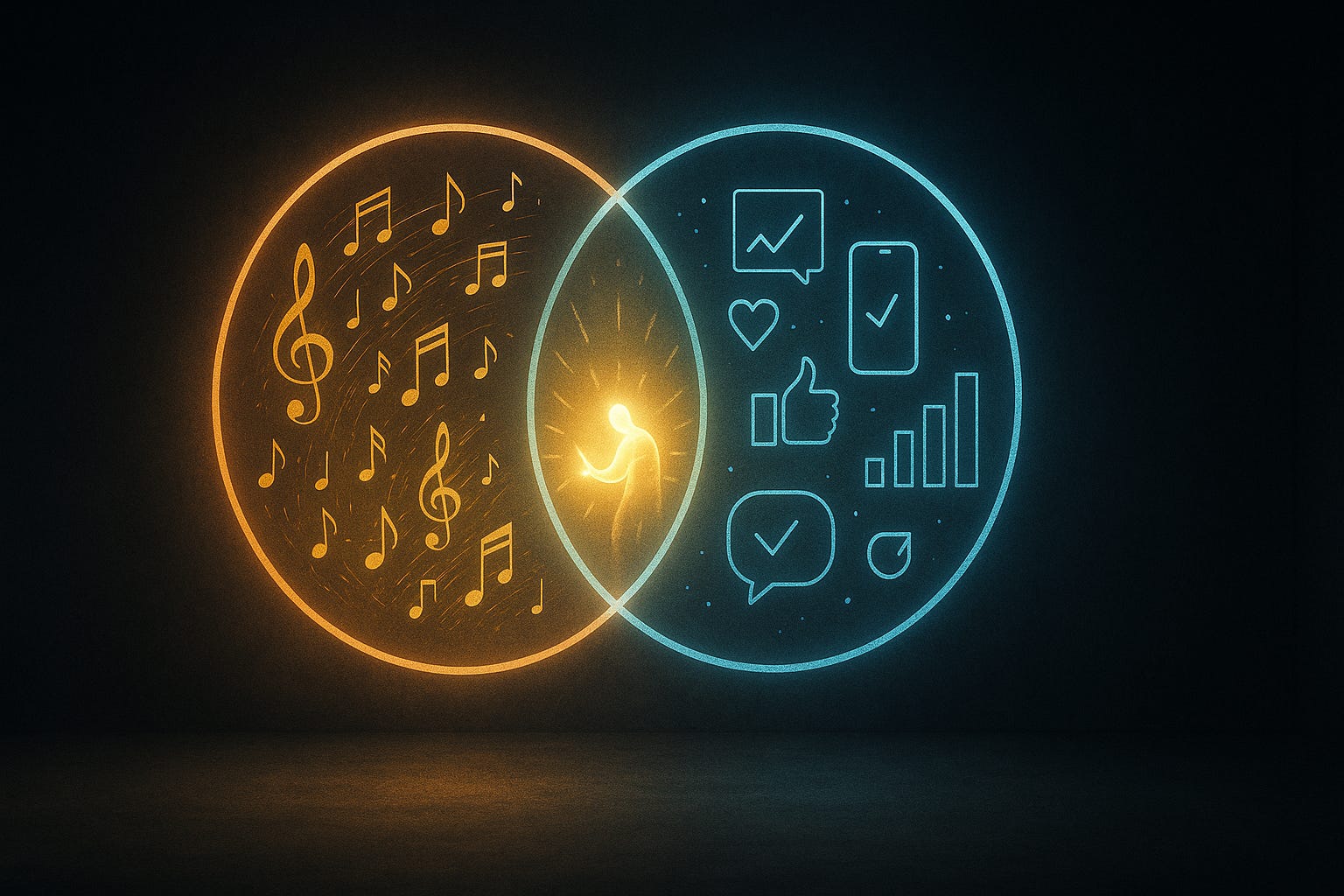
Imagine a Venn diagram.
One circle says, “Stuff I want to make.”
The other says, “Stuff people want to read, watch, or buy.”
Sometimes they overlap beautifully.
Most of the time, they barely touch.
That gap is the creator’s dilemma.
This space is built for people who care about the future—not just the shiny version, but the human one. If that sounds like you, consider upgrading to a paid subscription. You’ll be helping to keep independent thinking alive and unfiltered.
The Pull of the Inner Circle
Every creative act starts with curiosity.
You get obsessed with an idea. You follow it down a rabbit hole.
You make something because you can’t not make it.
That’s the purest kind of creation—the one without expectation.
You’re writing a song for yourself. Painting for yourself. Building a weird app because the idea won’t leave you alone.
That’s how the best work often begins.
But the moment you share it, you cross a line.
Now you’re not just creating for yourself.
You’re performing for an audience.
And audiences have tastes, habits, and short attention spans.
What starts as art quickly becomes content.
The Drift Toward the Outer Circle
The minute something you make resonates, pressure kicks in.
Do that again, they say.
That post did well—make another one like it.
That video blew up—do the same formula next week.
And suddenly, you’re not steering anymore.
The audience is.
You’ve become a mirror reflecting what they want instead of a window into what you believe.
That’s how creators lose their voice. Not overnight, but through a slow drift toward what “works.”
The algorithm rewards consistency. The market rewards predictability.
But creation was never supposed to be predictable.
The False Binary
It’s easy to frame this as a binary choice.
Do you make what you love, or do you make what pays?
But that’s the wrong question.
The real art of modern creation is finding the overlap and expanding it.
Because if you only chase the audience, you’ll burn out.
And if you only create for yourself, you’ll starve.
The trick is to treat the audience not as a master to serve, but as a collaborator to learn from.
Make what matters to you, then listen for where it resonates.
Algorithms and Attention
Once upon a time, artists created for the long arc of time.
Now, we create the refresh button.
The system that rewards attention punishes deviation.
If you post something slightly different, engagement dips.
If you experiment, people scroll.
It’s the algorithm’s way of whispering, “Stay in your lane.”
But if you never leave your lane, you’ll never find new ground.
Audiences may crave familiarity, but they also sense authenticity.
They know when you’re chasing approval.
They can feel when your work becomes mechanical.
The Invisible Hand of Feedback
Every comment, every metric, every “like” is a form of feedback.
And every form of feedback reshapes you, whether you mean it to or not.
It’s impossible not to care.
But the trick is not to eliminate feedback—it’s to decide how much weight to give it.
If your compass becomes external, you’ll always be chasing.
But if it stays internal, you can still adapt without losing your way.
Create with curiosity, not compliance.
The Economic Paradox
Money complicates everything.
Once your art starts paying the bills, it stops being “just art.”
It becomes your livelihood.
And livelihoods come with deadlines, expectations, audiences, and risk.
This is where the creator’s dilemma gets sharpest.
Do you chase the clicks and pay the rent?
Or do you slow down, follow the muse, and risk the silence?
Both are real. Both are valid.
And the answer changes over time.
Every creator eventually learns to dance between art and commerce—to feed both without starving either.
The Long Game
The good news is that authenticity compounds.
You might lose short-term traction when you pivot, experiment, or grow.
But over time, the audience that stays will be the one that actually matters.
That’s the overlap you want.
People who are here for you, not the algorithmic echo of you.
They’ll follow you through weird detours, topic shifts, and creative reinventions.
Because they’re not fans of a niche—they’re fans of a mind.
Those are your 100 true fans. The foundation of every sustainable creative career.
The Strategy of the Overlap
Here’s the real play:
Start with what you love.
Pay attention to what lands.
Then find the intersection—not by compromise, but by translation.
The audience doesn’t need you to pander.
They need you to make your world understandable to theirs.
The best creators don’t change their vision to fit the market.
They teach the market to see what they see.
That’s how innovation spreads—through translation, not surrender.
The AI Curve
AI adds a new layer to the dilemma.
When machines can generate endless content, human work will be judged differently.
Not on volume. Not on speed. But on voice.
AI can remix trends. It can’t invent taste.
The creator’s real edge is intuition—knowing when to bend toward the audience and when to break from it.
Because the machine will always follow patterns.
Humans are built to disrupt them.
The Freedom in Failure
There’s a kind of freedom that only failure gives you.
When no one’s watching, you can experiment.
When no one expects anything, you can explore.
That’s why many great breakthroughs happen after collapse.
The numbers drop. The pressure fades. The compass resets.
That’s when you remember why you started in the first place.
Failure is often the gate you walk through to rediscover truth.
The Decade Lens
If you want longevity as a creator, stop thinking in days and start thinking in decades.
The internet measures success in likes, but culture measures it in legacy.
A post is forgotten in 24 hours.
A body of work lasts for decades.
Stop chasing virality. Build consistency.
Because over ten years, the only audience that matters is the one you didn’t have to fake to keep.
Create Like a Lighthouse
A lighthouse doesn’t chase ships.
It shines for whoever’s out there.
That’s the mindset shift.
Make what matters to you, and the right audience will find its way in time.
The world doesn’t need more content.
It needs more conviction.
Don’t chase the overlap.
Expand it.
“Start with what you love. Pay attention to what lands.” This resonated with me. I appreciate the tension.
I like the concept of the overlap Chris and working to find it.
The part about "that hit, do it again" seems to be what movies and television do with sequels, prequels and reboots which I find very frustrating. I think of all the original ideas that are not getting their shot because it has to be a "franchise."
I'm at the point in my life where I want to do and create what I love, and try to help others along the way. I'll get to do that in the overlap :)