

The Costliest Mistake Is Often the One You Never Make
Why timidity may be more expensive than failure


We Spend Too Much Time Avoiding the Wrong Risk
Most people think about mistakes in a very visible way. A failed business, a rejected proposal, a bad investment, a product that never finds customers, or a creative project that falls flat all leave evidence behind. They create stories we can tell, lessons we can learn, and occasionally scars we would rather not have accumulated.
Because mistakes are visible, they attract a disproportionate amount of attention. Entire educational systems are built around avoiding them. Organizations create processes to minimize them. Individuals often spend years developing strategies designed to reduce the likelihood of making them. It is easy to conclude that the path to a successful life is primarily about becoming increasingly effective at avoiding failure.
The problem with this mindset is that it focuses on only one side of the ledger.
While mistakes are easy to see, another category of loss often goes completely unnoticed. Opportunities not pursued, ideas not shared, businesses not started, relationships not initiated, and experiments never attempted rarely leave behind visible evidence. There is no record of what might have happened. No report is generated. No headline is written. Yet those unrealized possibilities often carry costs that exceed the consequences of many mistakes.
The risk we see tends to dominate our decision-making. The risk we do not see often shapes our lives far more profoundly.
This space is built for people who care about the future—not just the shiny version, but the human one. If that sounds like you, consider upgrading to a paid subscription. You’ll be helping to keep independent thinking alive and unfiltered.
Mistakes Produce Information
One of the strange advantages of mistakes is that they create clarity.
When you launch something and it fails, you learn something. The lesson may not always be pleasant, but uncertainty is reduced. You discover what customers value, what audiences respond to, what assumptions were wrong, and where reality differs from expectation. The outcome may not be what you wanted, but it is still an outcome.
Timidity produces a very different result.
When an idea never leaves your notebook, uncertainty remains intact. When a business never launches, there is no feedback. When a creative project never reaches an audience, there is no data. The questions that could have been answered remain unanswered indefinitely.
This creates an asymmetry that many people overlook. Mistakes frequently move you forward because they generate information. Inaction often preserves uncertainty because it generates nothing at all. Over long periods of time, people who accumulate information tend to outperform people who accumulate caution.
That does not mean every action succeeds. It means that action produces learning while hesitation often preserves ignorance.
Most Success Stories Are Built on Incorrect Guesses
When people study successful companies, creators, entrepreneurs, inventors, or innovators, they often focus on the breakthrough itself. History compresses events into tidy narratives that make outcomes appear more intentional than they really were.
The reality is usually much messier.
Successful founders often begin with products that fail. Writers produce drafts that never see publication. Inventors pursue dead ends. Creators spend years producing work that attracts little attention. Scientists explore hypotheses that turn out to be wrong. What appears in retrospect to be a carefully executed plan is often the result of repeated experimentation and adjustment.
The common thread is not extraordinary foresight.
It is a willingness to act before certainty exists.
People who eventually discover successful paths are often the people who were willing to explore unsuccessful ones first. Their advantage comes less from avoiding mistakes and more from treating mistakes as part of the discovery process. They understand that progress emerges through interaction with reality rather than through endless analysis conducted at a safe distance.
The Modern World Rewards Experimentation
This dynamic becomes even more important during periods of rapid change.
In stable environments, caution can be an effective strategy. If markets evolve slowly, technologies remain consistent, and social systems change gradually, careful planning can provide significant advantages. Historical knowledge remains relevant for longer periods, and optimization often matters more than exploration.
The modern world increasingly operates under different conditions.
Technologies evolve rapidly. Entire industries can transform within a decade. New opportunities emerge unexpectedly. Established assumptions become obsolete more quickly than they once did. Under these conditions, experimentation becomes a critical capability because the future cannot be understood solely by studying the past.
People who act gather information faster than people who wait. They discover emerging opportunities earlier. They identify changing conditions sooner. Most importantly, they develop a habit of adaptation rather than a dependence on certainty.
In a rapidly changing environment, the ability to learn quickly often becomes more valuable than the ability to avoid mistakes.
We Consistently Underestimate Opportunity Cost
Human beings are remarkably good at noticing losses that occur.
We are much worse at noticing losses that never materialize into visible events.
If someone invests money in a poor business idea and loses $10,000, the loss is obvious. If another person never pursues a business idea that might have generated a million dollars, there is no visible record of the missed opportunity. One loss becomes memorable. The other disappears into the background.
This bias influences countless decisions.
People focus on the embarrassment of rejection while ignoring the relationships that never form. They focus on the possibility of launching something imperfect while ignoring the benefits that might emerge from sharing their work. They focus on what could go wrong while giving far less attention to what could go right.
The result is a worldview that systematically overestimates the dangers of action and underestimates the dangers of inaction.
If opportunity costs were displayed as clearly as financial losses, many people would make very different decisions.
AI Is Reducing the Cost of Exploration
One of the most interesting effects of AI is that it lowers the cost of experimentation across many domains.
Ideas can be explored more quickly. Prototypes can be built faster. Research can be conducted in hours rather than weeks. Creative concepts can be tested without requiring large teams or significant upfront investment. Individuals can investigate possibilities that would previously have been inaccessible due to time, expertise, or resource constraints.
This matters because lower experimentation costs should encourage greater exploration.
Historically, many people hesitated because being wrong was expensive. Building the wrong product could consume months or years. Pursuing the wrong direction could represent a significant personal or financial risk. AI does not eliminate those risks entirely, but it often reduces them enough that more experimentation becomes rational.
Ironically, many people still operate with psychological models inherited from a world where experimentation was much more expensive. They continue waiting for certainty even as the cost of discovering reality declines dramatically.
That gap between technological possibility and human behavior may become increasingly important in the years ahead.
Courage Is a Relationship With Uncertainty
People often misunderstand courage.
They imagine courageous individuals as people who possess unusual confidence or who simply do not experience fear. In practice, many successful creators, entrepreneurs, inventors, and innovators experience exactly the same doubts and anxieties as everyone else.
The difference is usually not emotional.
It is philosophical.
They develop a different relationship with uncertainty. Rather than treating uncertainty as a reason to stop, they treat it as a normal condition of progress. They recognize that waiting for complete confidence often means waiting forever because reality rarely provides guarantees in advance.
This mindset does not eliminate mistakes. In fact, it often produces more mistakes in the short term. What it also produces is more information, more learning, more adaptation, and ultimately more opportunities for meaningful success.
Over time, those benefits compound.
The Opportunities That Never Got a Chance
Many mistakes can be recovered from. Businesses fail and people start new ones. Creative projects disappoint and better projects follow. Wrong turns are taken and new directions emerge. Human beings are often far more resilient than they initially imagine.
The opportunities that never receive a chance are harder to recover. An experiment that never happens cannot generate insight. An idea that never leaves your mind cannot influence the world. A possibility that is never explored cannot reveal what it might have become.
This is why timidity can become surprisingly expensive over the course of a lifetime.
The visible costs of mistakes often dominate our attention, but the invisible costs of hesitation quietly accumulate in the background. By the time we notice them, they often appear not as failures, but as regrets.
And regrets are frequently nothing more than opportunities that were abandoned before reality had a chance to respond.
This space is built for people who care about the future—not just the shiny version, but the human one. If that sounds like you, consider upgrading to a paid subscription. You’ll be helping to keep independent thinking alive and unfiltered.
AI is cool, but what if you could actually use it as your life coach?
That’s what 10xYOU is all about—turning AI into extra income, more focus, and healthier habits. It’s like thinkfuture’s practical twin—same curiosity, but built for action.
Check out our 10xYOU publications:
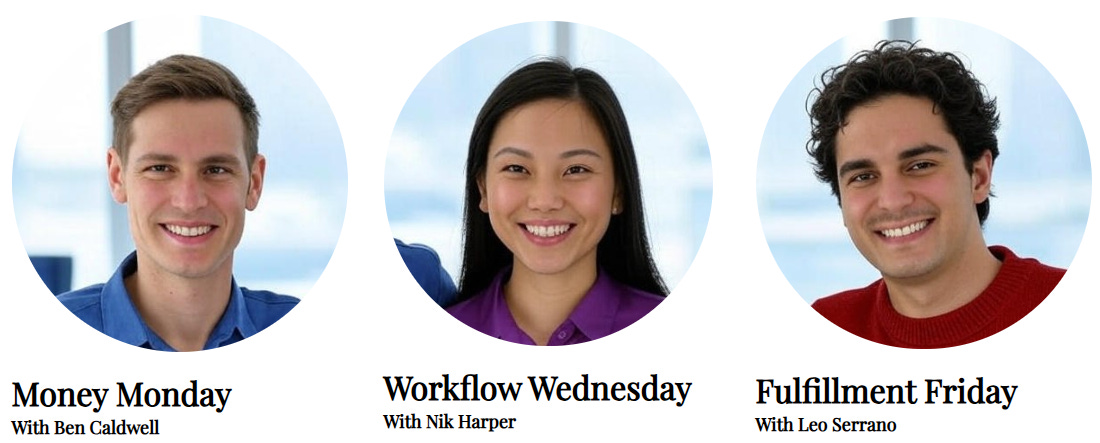
Money Monday with Ben Caldwell: Your AI Money Coach
Start your week with smart, stress-free money moves. Every Monday, Ben shares one actionable way to use AI to save, earn, or invest better. No fluff, no jargon—just practical steps you can use right away to make your money work harder for you.
Workflow Wednesday with Nik Harper: Your AI Productivity Coach
Every Wednesday, Nik shows you how to work smarter, not harder. From AI-powered tricks to practical workflow shifts, she’ll help you save time, cut stress, and actually enjoy your week. Quick reads, easy experiments, real results.
Fulfilment Friday with Leo Serrano: Your AI Wellness Coach
Fridays aren’t just the end of the week—they’re a reset. In Fulfillment Friday, Leo blends espresso-fueled storytelling, Nonna’s wisdom, and AI guidance to help you recharge and find balance. Each issue delivers a personal story, practical wellness strategies, and one simple “Friday Reset” challenge you can actually use before Monday.
Great article, Chris. I've got a project that's been festering inside me -- so this was a nice kick in the pants.