

The Algorithm Is the Audience
Who are you really creating for—the people or the machine?

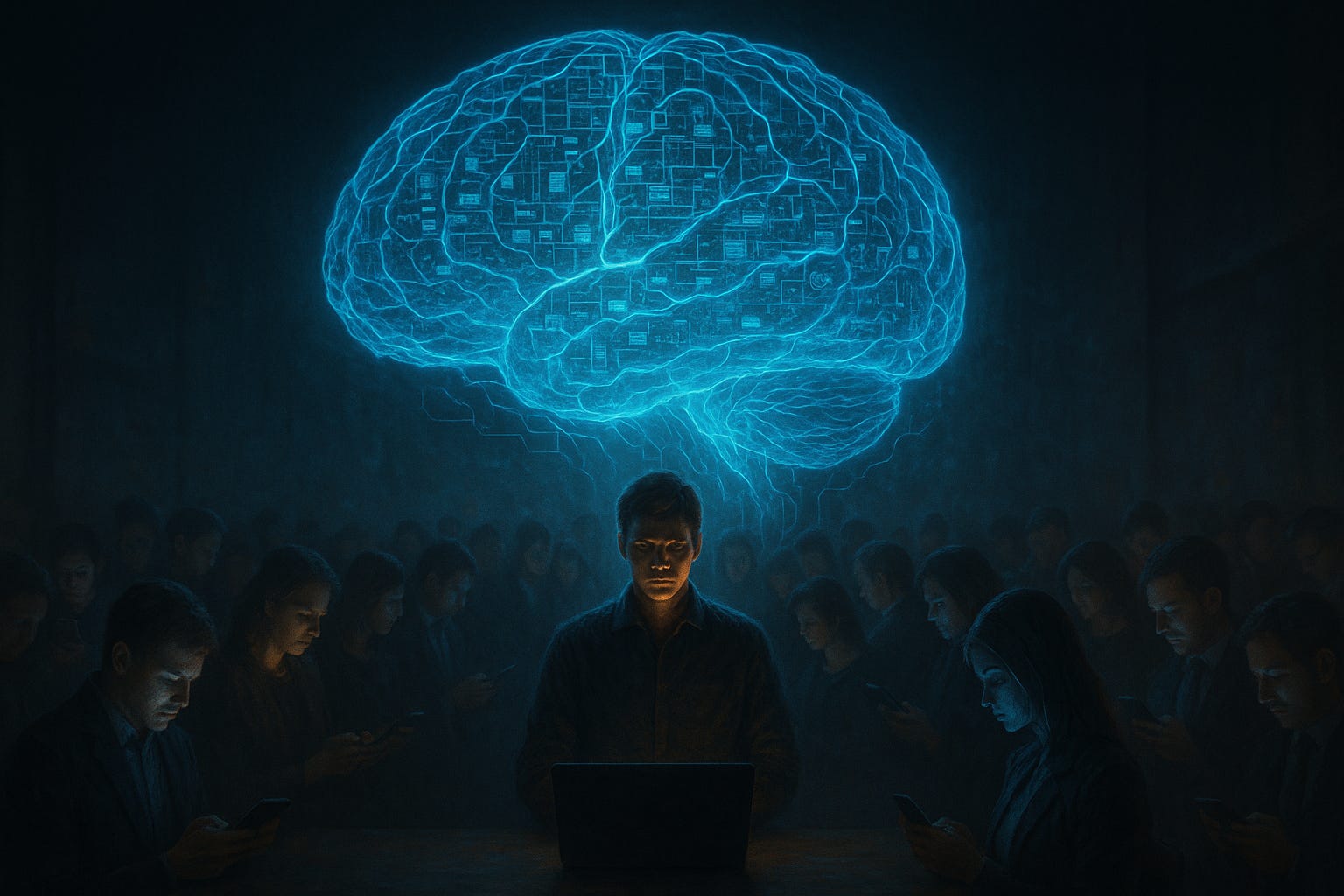
There’s a strange tension in being a creator today.
You write, film, design, or compose because you want to reach people. Real people. But before your work ever reaches them, it has to pass through an invisible gatekeeper.
That gatekeeper isn’t an editor or a publisher. It’s an algorithm.
And that means you’re no longer just writing for your audience. You’re writing for the machine that decides whether your audience will ever see it.
This space is built for people who care about the future—not just the shiny version, but the human one. If that sounds like you, consider upgrading to a paid subscription. You’ll be helping to keep independent thinking alive and unfiltered.
The New Middleman
The internet was supposed to democratize creativity.
Anyone could publish. Anyone could be seen. That was the dream.
But now, every platform—Substack, YouTube, Instagram, TikTok, X—filters your work through an opaque formula that decides who gets to see it, when, and how often.
It’s not an editor you can pitch or persuade. It’s math.
If the algorithm doesn’t like your work, it buries it.
If it does, it amplifies it.
And because of that, the algorithm has become your first audience.
Two Audiences, One Creator
So now you have two audiences:
The first is human. The readers, viewers, and listeners who connect with your message.
The second is algorithmic. A machine that decides if your content fits the patterns of what “works.”
You can’t ignore either one.
If you write only for the people, the machine might never show your work to them.
If you write only for the machine, the people will see it—but won’t care.
It’s a paradox every creator lives with, whether they realize it or not.
The Seduction of the Machine
Algorithms are predictable. They reward what they understand: frequency, consistency, and engagement.
Post more. Hook faster. Stay on topic. Avoid silence.
Humans, on the other hand, are unpredictable. They crave surprise, honesty, authenticity, and emotion.
The problem is that surprise and authenticity often look messy. And messy doesn’t perform well on platforms that crave pattern.
So creators start sanding down the rough edges of their work to fit the mold. They post less of what they love and more of what “does well.”
It’s subtle at first.
A headline tweak here.
A topic adjustment there.
Then one day, you realize you’re not making what you love anymore. You’re making what the machine loves.
The Invisible Training Loop
Every like, every comment, every click trains the algorithm.
But it also trains you.
You start to internalize what gets rewarded. You adjust your rhythm to match its cadence.
You stop experimenting because experiments don’t get engagement. You stop taking risks because risks get punished.
You learn to optimize for visibility instead of originality.
And the system smiles. Because that’s exactly what it wants.
The False Promise of Fairness
We like to think the internet is a meritocracy. That great ideas rise to the top.
But the truth is that algorithms reward familiarity, not originality. They surface what looks like what’s already popular.
So if you’re early, nuanced, or ahead of your time, the system will often ignore you.
The machine isn’t evil. It’s just indifferent. It cares only about engagement, not meaning.
And that’s a dangerous thing—to have cultural gatekeepers that don’t understand culture.
The Balance Game
So who do you write for? The people or the machine?
The answer is both—but not equally.
The machine is a translator. You have to speak its language just enough for it to deliver your message to the humans.
But once it does, your words must still matter to people.
The trick is balance:
Write with the heart, but format with the algorithm in mind.
That means you can care about hooks and structure without losing your voice.
You can optimize presentation without compromising meaning.
It’s not selling out. It’s learning to communicate through a noisy system.
The Economic Truth
Platforms aren’t neutral. They need to pay bills.
And that means they will always shape the algorithm to serve the platform’s financial goals, not the creator’s artistic goals.
If outrage drives clicks, outrage wins.
If quantity drives ad impressions, quantity wins.
If repetition keeps people scrolling, repetition wins.
The algorithm’s job isn’t to elevate quality. It’s to sustain attention.
And attention is currency.
That’s why you can’t rely on the machine to reward what’s good. It will reward what performs.
Those are not the same thing.
Building Beyond the Feed
Creators who last learn to treat the algorithm like a stepping stone, not a home.
Use it to find your people. But once you have them, move them somewhere the machine can’t interfere.
That’s why newsletters, communities, podcasts, and direct relationships matter so much.
They break the dependency loop. They let you build an audience that belongs to you, not a platform.
Because the moment you depend entirely on an algorithm, you’ve built your house on rented land.
The platform can change the rules tomorrow, and your reach disappears overnight.
If you’ve ever felt that panic—the sudden drop in engagement for no reason—you’ve already seen it happen.
Hope and Uncertainty
We like to hope that algorithms will get better. That they’ll learn to reward nuance, quality, and authenticity.
And maybe they will.
But don’t count on it. Because the platform doesn’t need “better.” It needs to be profitable.
A smarter algorithm won’t necessarily mean a fairer one. It’ll just mean a more efficient attention engine.
That’s the part we often forget. The algorithm isn’t a neutral filter—it’s an economic machine.
It doesn’t evolve toward truth. It evolves toward revenue.
The Human Algorithm
The irony is that humans act like algorithms too.
We follow patterns. We crave validation. We click what’s familiar.
In some ways, the algorithm is just holding up a mirror to us.
The more we feed it with shallow behavior, the shallower it becomes.
So if we want a better algorithm, we have to be better users.
We have to reward depth when we see it.
We have to slow down, engage longer, and think harder.
Otherwise, we’ll keep getting the internet we deserve—fast, loud, and empty.
The Future Audience
The creators who will win in the next decade will master the balance.
They’ll know how to write for both audiences—the algorithm that delivers the message and the humans who keep it alive.
They’ll learn to package truth in formats the machine understands.
They’ll be fluent in both authenticity and optimization.
Because creativity isn’t dying. It’s evolving.
And the best creators will be translators between art and system, meaning and metrics, and signal and noise.
The Real Algorithm
The algorithm isn’t some external entity.
It’s a reflection of us—our clicks, our habits, and our curiosity.
If you want to change it, change what you feed it.
Create for the humans, communicate for the machine.
Because the machine doesn’t care about beauty, truth, or depth.
But humans do.
And at the end of the day, they’re still the ones worth writing for.
So, for a while I’ve been trying to sell digital products online, but I’ve never had a lot of traction. I dug into the problem and figured out that the real reason is that there are 5 specific things that need to align to make sure that your product sells.
I applied these to my products, and boom—there they went.
It’s all in the PDF below. Check it out.

So true! F the Al Gore Rhythm!