

What If School Taught Only What Actually Matters?
What children actually need to learn in the AI age

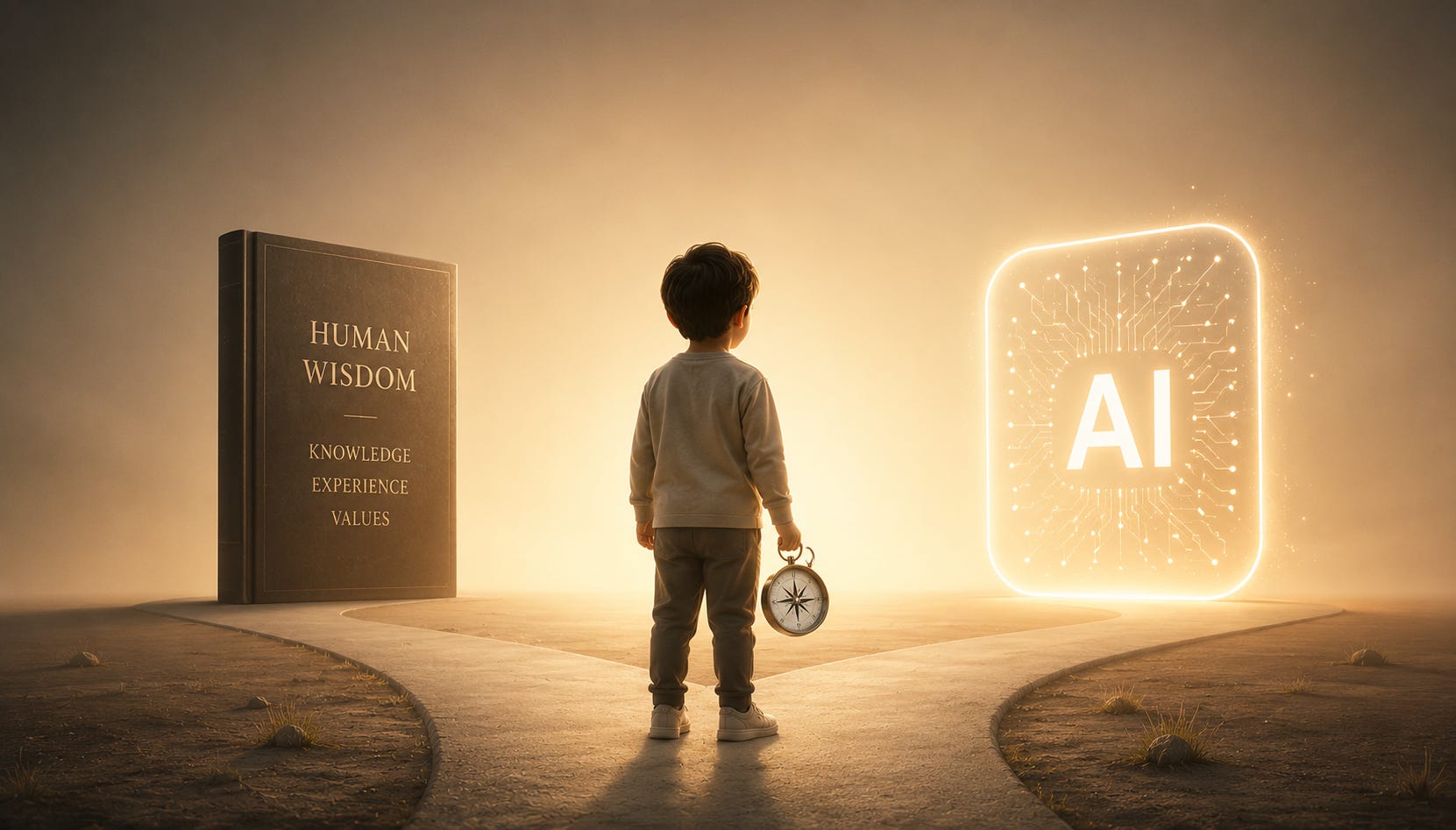
We Need to Rethink the Purpose of Education
Artificial intelligence forces us to ask a question that education systems have largely been able to avoid for generations: what, exactly, are we trying to produce?
For most of modern history, the answer seemed relatively straightforward. Education existed to transfer knowledge, build useful skills, socialize young people into functioning adults, and prepare them for economic participation. That framework made sense in a world where information was scarce, expertise was concentrated, and access to high-quality instruction was inherently limited by geography, institutions, and human availability.
AI changes those assumptions profoundly.
When an intelligent system can explain concepts instantly, provide tutoring on demand, generate examples, adapt explanations to the learner, assist with writing, support coding, and increasingly function as a collaborative thinking partner, it becomes necessary to distinguish between what humans truly need to learn and what can be increasingly outsourced to systems around them.
This is not an argument for reducing educational ambition. If anything, it is the opposite. But it does suggest that education in the AI age should become much more deliberate about separating essential human development from historical academic habits that may no longer serve their original purpose.
This space is built for people who care about the future—not just the shiny version, but the human one. If that sounds like you, consider upgrading to a paid subscription. You’ll be helping to keep independent thinking alive and unfiltered.
Knowledge Matters, but Knowledge Hoarding Matters Less
One easy but deeply flawed conclusion is that if AI can answer questions, then knowledge itself becomes unimportant. That conclusion misunderstands the relationship between knowledge and judgment.
A child without foundational knowledge is not empowered by AI. That child becomes dependent on AI. Without conceptual understanding, it becomes difficult to assess whether an answer is coherent, incomplete, misleading, biased, or simply incorrect. Knowledge still provides the mental scaffolding required to evaluate what a machine presents.
What changes is not the value of understanding, but the value of memorization for its own sake.
Historically, retention mattered because retrieval was difficult. If information was not stored internally, it might not be accessible when needed. That made memorization economically rational. In a world where retrieval is nearly instantaneous, the balance shifts. Children still need foundational understanding in mathematics, science, language, history, and systems thinking, but the educational obsession with stockpiling facts may become less defensible than building the mental frameworks that allow learners to interpret and apply knowledge intelligently.
The distinction is subtle but important. Education should not produce empty prompt operators who know how to ask machines questions but lack the intellectual foundation to understand the answers.
Critical Thinking Becomes the Core Product
If machines increasingly provide answers, then education must place much greater emphasis on helping children think about answers.
This may be one of the most important shifts in the entire educational model. A child growing up in the AI age will be surrounded by systems capable of generating plausible explanations, persuasive narratives, polished writing, and highly confident outputs. Some of those outputs will be useful. Some will be flawed. Some will be misleading in ways that are difficult to detect without disciplined reasoning.
This makes critical thinking far more than a nice educational ideal. It becomes a survival skill.
Logic, argument evaluation, skepticism, evidence assessment, pattern recognition, contradiction detection, and intellectual humility all become essential capabilities. The goal is not simply to create students who can produce acceptable answers, but students who can interrogate answers effectively, including those produced by intelligent systems that appear authoritative.
A learner who cannot reason critically becomes increasingly vulnerable in an AI-rich environment. A learner who can reason well becomes dramatically more capable because AI becomes leverage rather than dependency.
Asking Better Questions May Matter More Than Knowing Immediate Answers
One of the more interesting consequences of AI is that it changes where intellectual advantage lives.
When answers are scarce, possessing answers creates value. When answers are abundant, the ability to frame better questions becomes much more valuable.
This is not merely about prompt engineering, although that may matter tactically. It is about a broader habit of mind. Children should learn how to frame problems clearly, decompose ambiguity, identify assumptions, challenge premises, and pursue meaningful lines of inquiry. Those skills create leverage across every discipline because they determine the quality of both human and machine-assisted thinking.
Traditional education often rewards answer production. The AI age may require much stronger emphasis on inquiry itself.
A curious child who knows how to think structurally about problems will often outperform a child trained primarily to retrieve expected responses. That shift should influence how we think about curriculum design, classroom discussion, and intellectual development more broadly.
Human Capabilities Become More Valuable, Not Less
A common narrative suggests that as AI becomes more capable, human relevance shrinks. That interpretation misses something important.
As machines become stronger at procedural tasks, distinctly human capabilities become more valuable.
Communication, empathy, collaboration, negotiation, trust-building, emotional regulation, leadership, ethical reasoning, and interpersonal judgment are not secondary “soft skills.” They may become primary differentiators in a world where machines increasingly handle information-heavy procedural work.
This has major implications for education because many school systems still treat these capabilities as peripheral to the “real” academic mission. They are often underdeveloped, inconsistently taught, or assumed to emerge automatically through social experience.
That assumption may no longer be acceptable.
If future economic and social environments increasingly reward human relational capability, then education should treat those capacities as central developmental objectives rather than incidental side effects.
Adaptability Should Be a First-Class Educational Outcome
The industrial educational model assumed relative stability. Learn a profession, develop competence, and apply that capability for long stretches of life with occasional adjustment.
That model becomes increasingly fragile in an AI-accelerated world.
Industries change faster. Roles evolve more rapidly. Skills lose relevance more quickly. Career identities become less stable. Children entering today’s classrooms may work in environments that change repeatedly over their lifetimes in ways that are difficult to predict.
That suggests adaptability should become one of education’s most explicit goals.
Children should learn how to learn efficiently. They should develop confidence in entering unfamiliar domains, building competence from scratch, tolerating uncertainty, experimenting with incomplete information, and adjusting when assumptions fail. These are not niche skills for unusual careers. They increasingly resemble general operating capabilities for modern life.
An education system that produces highly competent but brittle thinkers may be producing exactly the wrong kind of resilience.
AI Literacy Needs to Become Foundational
Digital literacy used to mean learning how to use computers and online systems effectively. That definition now feels incomplete.
Children increasingly need AI literacy—not merely as users, but as informed participants in environments shaped by synthetic intelligence.
They need to understand what AI does well, where it fails, how hallucinations occur, how persuasive outputs can be misleading, how machine-generated systems reflect bias, and how dependency can quietly form when systems appear helpful and frictionless.
This does not require turning every student into a technical specialist. It does require conceptual fluency.
A generation that grows up using AI without understanding its operating characteristics risks becoming dependent on systems they cannot critically evaluate. That creates a dangerous asymmetry between convenience and comprehension.
Minimum viable education in the AI age should absolutely include the ability to navigate intelligent systems with informed skepticism and practical understanding.
Education Still Needs to Build Humans, Not Just Workers
There is a risk in discussions like this that education becomes framed too narrowly as economic preparation.
That would be a mistake.
Education is also about human formation.
Children need ethical frameworks, cultural understanding, creativity, historical perspective, civic awareness, identity development, and opportunities to wrestle with meaning. These capacities matter regardless of labor market shifts because they shape what kind of adults children become.
AI changes many aspects of learning, but it does not eliminate the importance of helping young humans become thoughtful, grounded, self-aware people.
If anything, the abundance of machine-generated content may make internal orientation even more important. A world saturated with synthetic outputs increases the need for authentic judgment, values, and personal meaning-making.
Education should not become narrower in response to AI.
It should become sharper.
It’s Not The Least Amount Of Education
Minimum viable education should not mean minimal education.
It should mean ruthless clarity about what truly matters.
If AI increasingly handles retrieval, procedural assistance, explanation, and collaborative support, then education must focus more intentionally on what humans need in order to flourish independently and intelligently in that environment.
Foundational knowledge still matters. Critical thinking matters more. Question framing matters more. Human relational capability matters more. Adaptability matters more. AI literacy matters. Meaning matters.
The industrial educational model optimized for a world of informational scarcity.
The AI age demands an educational model optimized for human judgment.
That is a very different design brief.
This space is built for people who care about the future—not just the shiny version, but the human one. If that sounds like you, consider upgrading to a paid subscription. You’ll be helping to keep independent thinking alive and unfiltered.
AI is cool, but what if you could actually use it as your life coach?
That’s what 10xYOU is all about—turning AI into extra income, more focus, and healthier habits. It’s like thinkfuture’s practical twin—same curiosity, but built for action.
Check out our 10xYOU publications:

Money Monday with Ben Caldwell: Your AI Money Coach
Start your week with smart, stress-free money moves. Every Monday, Ben shares one actionable way to use AI to save, earn, or invest better. No fluff, no jargon—just practical steps you can use right away to make your money work harder for you.
Workflow Wednesday with Nik Harper: Your AI Productivity Coach
Every Wednesday, Nik shows you how to work smarter, not harder. From AI-powered tricks to practical workflow shifts, she’ll help you save time, cut stress, and actually enjoy your week. Quick reads, easy experiments, real results.
Fulfilment Friday with Leo Serrano: Your AI Wellness Coach
Fridays aren’t just the end of the week—they’re a reset. In Fulfillment Friday, Leo blends espresso-fueled storytelling, Nonna’s wisdom, and AI guidance to help you recharge and find balance. Each issue delivers a personal story, practical wellness strategies, and one simple “Friday Reset” challenge you can actually use before Monday.
The skills this article highlights—critical thinking, adaptability, asking better questions, AI literacy, and relationship building—are becoming just as important for employees as they are for students.
The question I keep coming back to is whether our schools and workplaces are actually designed to develop these capabilities. Many were built around compliance, standardization, and producing the "right" answer. The AI era seems to reward curiosity, judgment, and participation instead.
You focus a lot on what students should learn. How is that different from what teachers should teach?