

Humans Are Still Awesome
Why our ability to imagine, invent, and evolve makes us more vital than ever in an age of accelerating technology.

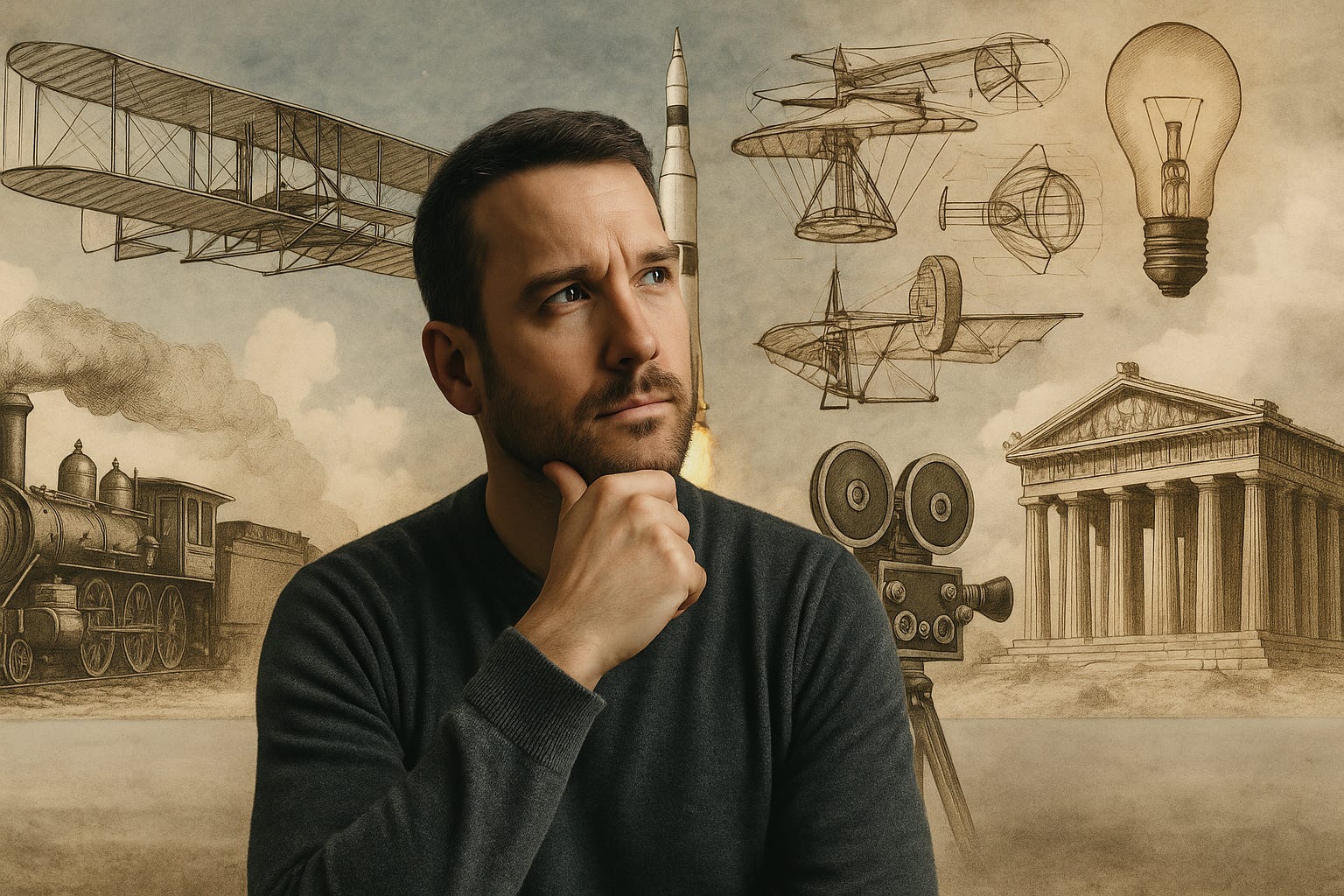
“Oh, what a piece of work is man.”
Every once in a while, it’s worth pausing to really let that sink in.
Take a breath. Look around you.
Everything in your field of vision—unless you happen to live in one of those few untouched corners of the Earth—is a product of human imagination.
The chair you’re sitting in. The road outside. The city surrounding that road. The car driving down it. The phone in your hand. The coffee beside you.
Every single one of those things exists because a human being dreamed it up.
The Era of the Human-Built
It’s easy to take it for granted.
We scroll. We order. We drive. We Zoom. We tap little icons on glowing glass rectangles that summon food, rides, entertainment, and answers in seconds.
But pause for a moment:
This is extraordinary.
The devices on our desks. The medicines keeping us alive longer. The games entertaining us. The coffee machines caffeinating us.
These are the products of human thought, persistence, and curiosity.
We live in the era of the human-built. And it’s breathtaking—if you let yourself notice.
But Haven’t We Made Too Much?
Of course, there’s a shadow side.
Do we have too many “things”? Probably. Do we sometimes invent for the sake of novelty instead of need? Definitely.
But whose fault is that?
Is it the creators pushing boundaries? Or is it us—the ones demanding, buying, consuming?
In truth, it’s both. And maybe that’s okay.
Because the drive to create—whether for survival, comfort, or joy—is what makes us human.
And that drive? It’s not slowing down.
The Next Wave of Human-Built
Soon we’ll see technologies that feel like science fiction:
General AI that doesn’t just respond but reasons.
Quantum computing that makes today’s supercomputers look like pocket calculators.
And some people see that and panic.
They say:
“That’s it. Once AI gets smart, our time in the sun is over.”
But here’s the thing: I don’t buy it.
Humans + Machines = More Human Power
Why?
Because humans don’t disappear when we build new tools.
We amplify.
The printing press didn’t make storytellers irrelevant—it made them immortal.
The internet didn’t destroy knowledge—it democratized it.
And AI? It’s not replacing us. It’s extending us.
Can’t solve climate change? Build a machine that helps us think through it.
Can’t cure a disease? Use AI to design the molecules that might.
Technology isn’t an ending. It’s a multiplier.
Fear vs. Potential
I get why people default to dystopia.
Movies, headlines, and social media love a good apocalypse. A future ruled by killer robots is a better click than a future where AI helps us make better policy.
But here’s what I see: Technology is a tool.
It’s a mirror, reflecting our best and worst instincts.
We choose how to use it.
We can use it to stagnate or to elevate. To numb ourselves or to evolve ourselves.
The tool doesn’t define us. Our intent does.
Why Humans Still Matter Most
This is the piece people forget:
No matter how advanced our machines become, they’re still our creations.
They’re built on human language, culture, ethics, and values.
They don’t dream. They don’t desire. They don’t hope.
We do.
That spark—the messy, unpredictable, profoundly human urge to imagine something better—is what makes all of this possible.
And it’s not going away.
Never Underestimate the Human Mind
Everything you see around you started as a thought.
Somewhere, in someone’s head.
A “what if.” A “why not.” A “could we?”
That’s the superpower of our species: to imagine things that don’t exist and bring them into reality.
And even as we build smarter machines, that superpower will remain uniquely ours.
In fact, it might be more important than ever.
So, Where Do We Go From Here?
If we can build quantum computers and general AI, what else can we build?
Cities that heal the environment instead of destroying it.
Food systems that feed everyone without depleting the planet.
Technologies that give us not just longer lives—but better ones.
These aren’t fantasies. They’re possibilities.
But only if we keep leaning into the thing that’s gotten us this far: our ability to imagine, create, and evolve.
Humans Never Stop Being Awesome
In a world obsessed with what machines can do, let’s not forget what humans have already done—and what we’re still capable of.
We’ve invented languages, mapped the stars, built networks that connect billions of us across the globe, and cured diseases that once wiped us out.
And we’re just getting started.
So the next time you look around at the tools, the buildings, the devices—the world of the human-built—remember:
This didn’t just happen. We made it happen.
And that makes us awesome.