

Embracing Superhuman AI
A future of flourishing, not collapse

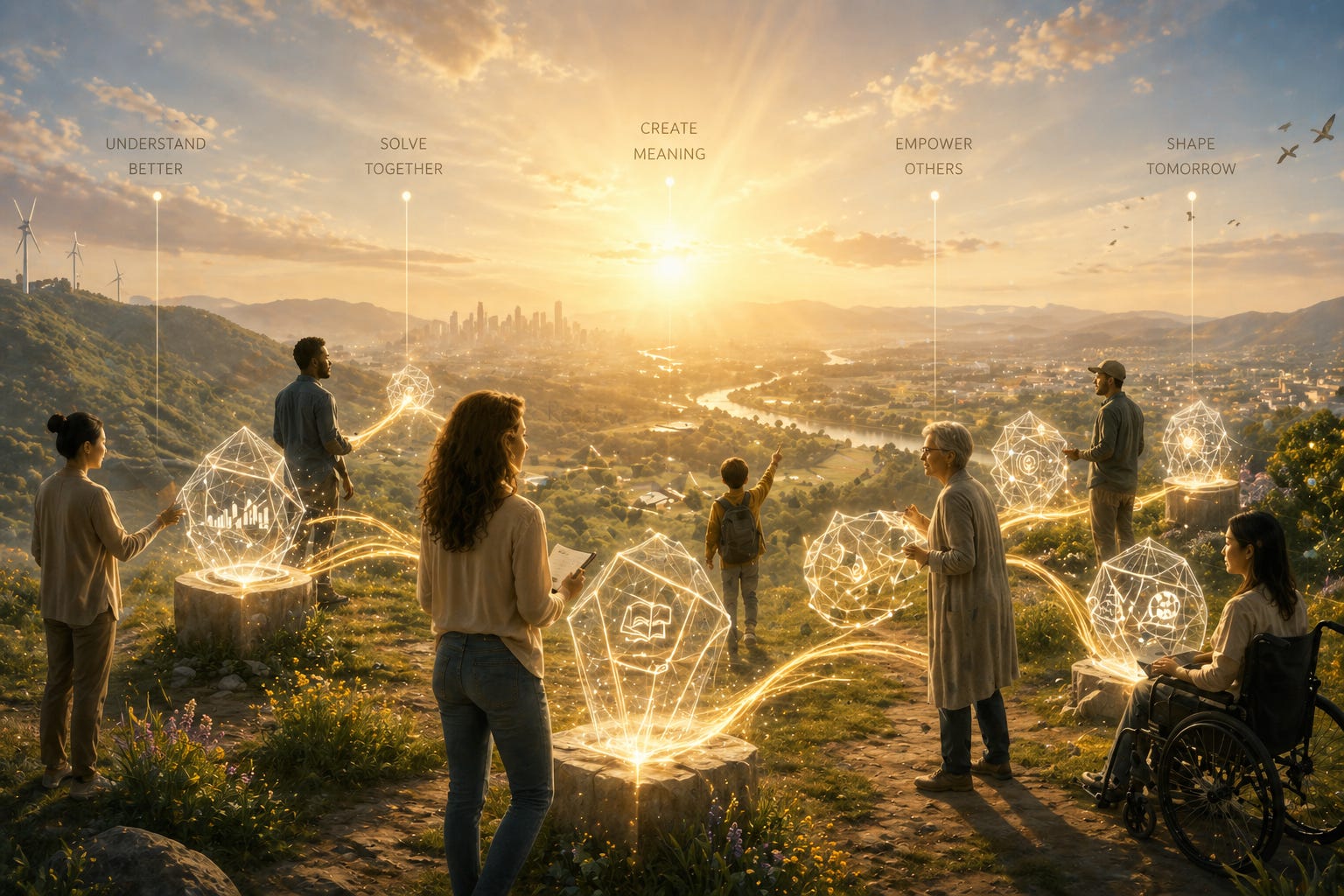
Much of the conversation around advanced AI assumes a negative trajectory. As systems become more capable, the expectation is displacement, loss of control, and a general erosion of human relevance. This framing is understandable. It reflects how people respond to rapid, uncertain change, especially when that change affects work, identity, and status.
But it is only one possible outcome.
A more grounded view is that increasingly capable AI systems will expand what humans can do, not eliminate the need for humans altogether. The effects will be uneven and sometimes disruptive, but the long-term direction does not have to be dystopian. It can be constructive.
This space is built for people who care about the future—not just the shiny version, but the human one. If that sounds like you, consider upgrading to a paid subscription. You’ll be helping to keep independent thinking alive and unfiltered.
The Pattern of Capability Expansion
Throughout history, new technologies have extended human capability. Tools have allowed individuals to operate at levels that were previously difficult or impossible to reach.
Industrial machinery increased physical output.
Computing increased analytical capability.
The internet increased access to information.
Each step raised the baseline.
AI continues this pattern, but instead of augmenting a narrow domain, it operates across many domains simultaneously. It can assist with writing, analysis, design, planning, and coordination. This breadth is what makes it feel different.
However, the underlying mechanism is familiar.
It extends capability.
What “Superhuman” Actually Means
When people hear “superhuman AI,” they often interpret it as a system that replaces human thinking entirely.
A more accurate interpretation is that AI can perform certain tasks at a level of speed, scale, or consistency that exceeds individual human capability.
That does not eliminate human contribution.
It changes where it is applied.
AI can generate options quickly.
It can process large volumes of data.
It can identify patterns across domains.
But it does not determine which outcomes are desirable. It does not assign meaning or value to decisions. It does not take responsibility for consequences.
Those remain human functions.
The Shift in Human Effort
As AI handles more execution, human effort shifts.
Less time is spent on routine production.
More time is spent on direction and interpretation.
This does not reduce effort. It changes its focus.
Deciding what to build becomes more important than building it.
Framing problems becomes more important than solving predefined ones.
The work moves upstream.
A More Capable Baseline
One of the most immediate effects of AI is the increase in baseline capability.
Tasks that once required significant training can now be performed with assistance. Individuals can produce outputs that were previously out of reach.
This does not eliminate expertise, but it raises the floor.
More people can participate in creating, analyzing, and building. This increases the number of ideas being tested and the diversity of perspectives contributing to the system.
That expansion has positive effects.
More experimentation leads to more variation.
More variation increases the probability of useful outcomes.
The Role of Human Judgment
As capability becomes more accessible, judgment becomes more important.
AI can suggest actions, but it does not decide which actions align with human goals. It does not weigh tradeoffs in a value-driven way.
This is where human input remains essential.
People determine priorities.
People evaluate consequences.
People decide what matters.
AI can support these decisions, but it does not replace them.
Flourishing as an Outcome
If AI is used to reduce friction and expand capability, it creates conditions that support human flourishing.
Individuals can explore more ideas with less cost.
Learning can become more interactive and adaptive.
Barriers to entry in many fields can be reduced.
This does not guarantee positive outcomes, but it increases the range of possible positive outcomes.
Flourishing is not automatic. It depends on how systems are used.
The Risk of Misuse
A constructive future is not guaranteed.
AI can also be used to optimize for short-term engagement, reinforce existing biases, or concentrate power.
These risks are real and need to be managed.
However, they do not define the technology itself.
They reflect choices in design, governance, and usage.
Avoiding Binary Thinking
The most limiting aspect of current discussions is binary thinking.
AI will either save us or destroy us.
It will either replace humans or empower them.
Reality is more complex.
AI will introduce tradeoffs. It will create both opportunities and challenges. The outcome will depend on how individuals and institutions respond.
Focusing only on worst-case scenarios reduces the ability to shape better ones.
A Practical Perspective
From a practical standpoint, embracing AI means integrating it into workflows in a way that complements human strengths.
Use it to accelerate iteration.
Use it to explore alternatives.
Use it to handle repetitive tasks.
At the same time, maintain control over direction and decision-making.
This balance allows the benefits to compound without ceding agency.
The Long-Term View
Over time, AI may become a standard layer in how work and creativity are performed.
It will be embedded in tools, platforms, and processes. It will shape how information is accessed and how decisions are supported.
This does not eliminate human involvement.
It changes the interface.
People interact with systems differently. They rely on them for different functions. They operate at different levels of abstraction.
It’s Not A Dystopia, But Not Quite Utopia
Superhuman AI does not require a dystopian outcome.
It represents an expansion of capability.
If that capability is directed effectively, it can support a future where individuals are more capable, more informed, and more able to act on their ideas.
The technology sets the conditions.
The outcome depends on how those conditions are used.
This space is built for people who care about the future—not just the shiny version, but the human one. If that sounds like you, consider upgrading to a paid subscription. You’ll be helping to keep independent thinking alive and unfiltered.
AI is cool, but what if you could actually use it as your life coach?
That’s what 10xYOU is all about—turning AI into extra income, more focus, and healthier habits. It’s like thinkfuture’s practical twin—same curiosity, but built for action.
Check out our 10xYOU publications:

Money Monday with Ben Caldwell: Your AI Money Coach
Start your week with smart, stress-free money moves. Every Monday, Ben shares one actionable way to use AI to save, earn, or invest better. No fluff, no jargon—just practical steps you can use right away to make your money work harder for you.
Workflow Wednesday with Nik Harper: Your AI Productivity Coach
Every Wednesday, Nik shows you how to work smarter, not harder. From AI-powered tricks to practical workflow shifts, she’ll help you save time, cut stress, and actually enjoy your week. Quick reads, easy experiments, real results.
Fulfilment Friday with Leo Serrano: Your AI Wellness Coach
Fridays aren’t just the end of the week—they’re a reset. In Fulfillment Friday, Leo blends espresso-fueled storytelling, Nonna’s wisdom, and AI guidance to help you recharge and find balance. Each issue delivers a personal story, practical wellness strategies, and one simple “Friday Reset” challenge you can actually use before Monday.
I thinking the issue is, that people don't like the fact that everyone now has access to AI.
I'm 50 I've heard of AI (even as we know it today)since the late 80s early 90s.
But unless you belonged to a major college, corporation, government agency, you didn't have access to them. They use to be called supercomputers, CGI, extra, systems that costed 100,000+.
Now for around 6000-10,000 you can have one that's the size of a playstation 4, trained and tuned to your tasks and I foresee these localized AI system getting even cheaper within the next 5-10 years. around the price tag of a good PC or Laptop. My generation the Decadence Generation(1970-79) will be the early adopters to these systems, since we tend to be early adopters for tech, but that makes sense since we we the 1st to grow up with it.
Younger generations, well they are on the anti AI trend wagon. It's trendy to be anti tech and it my generations fault for that. We bitch about it being in everything and making everything so complicated and when it quits working make it useless.( that's a lot of ands, LMAO). But they like whats be made. It's like headbanger like back in the 80s saying they do like a good power ballad.
Thing is those that use AI for more than mundane tasks are going to be the ones that, become rich from the use of it. That take it beyond coding, workflow stuff, brainstorming, extra. The ones that use it to workout theories, engineering problems, Basically how colleges, corporations and governments have been using them for decades.
That's why the big push suddenly to pass laws and regulations to restrict the use and soon we will even see regulations regarding private building of them.
I know I sound like a conspiracy theorist, but remember those in the 80s that said the government was spying on them through their TVs. Well back then they were tin foil hate wears. Little did we know that by 2007 governments actually would be.