

Attention Is Collapsing. Do We Fight It or Ride It?
The ability to focus for hours is vanishing. That may be the biggest challenge—and opportunity—of our age.

We’ve all felt it.
You open a book, and after three pages your brain whispers: check your phone.”
You sit down to write, and fifteen minutes in you’re knee-deep in YouTube, Slack, TikTok, and email.
Even conversations with friends are punctuated with glances at glowing screens.
It’s not just you. Attention spans are collapsing.
We live in an economy built on distraction. Every app, every feed, every notification has one goal: slice your focus into smaller, monetizable pieces. The result? Our ability to do anything for an extended period of time—reading, creating, solving complex problems—is collapsing alongside it.
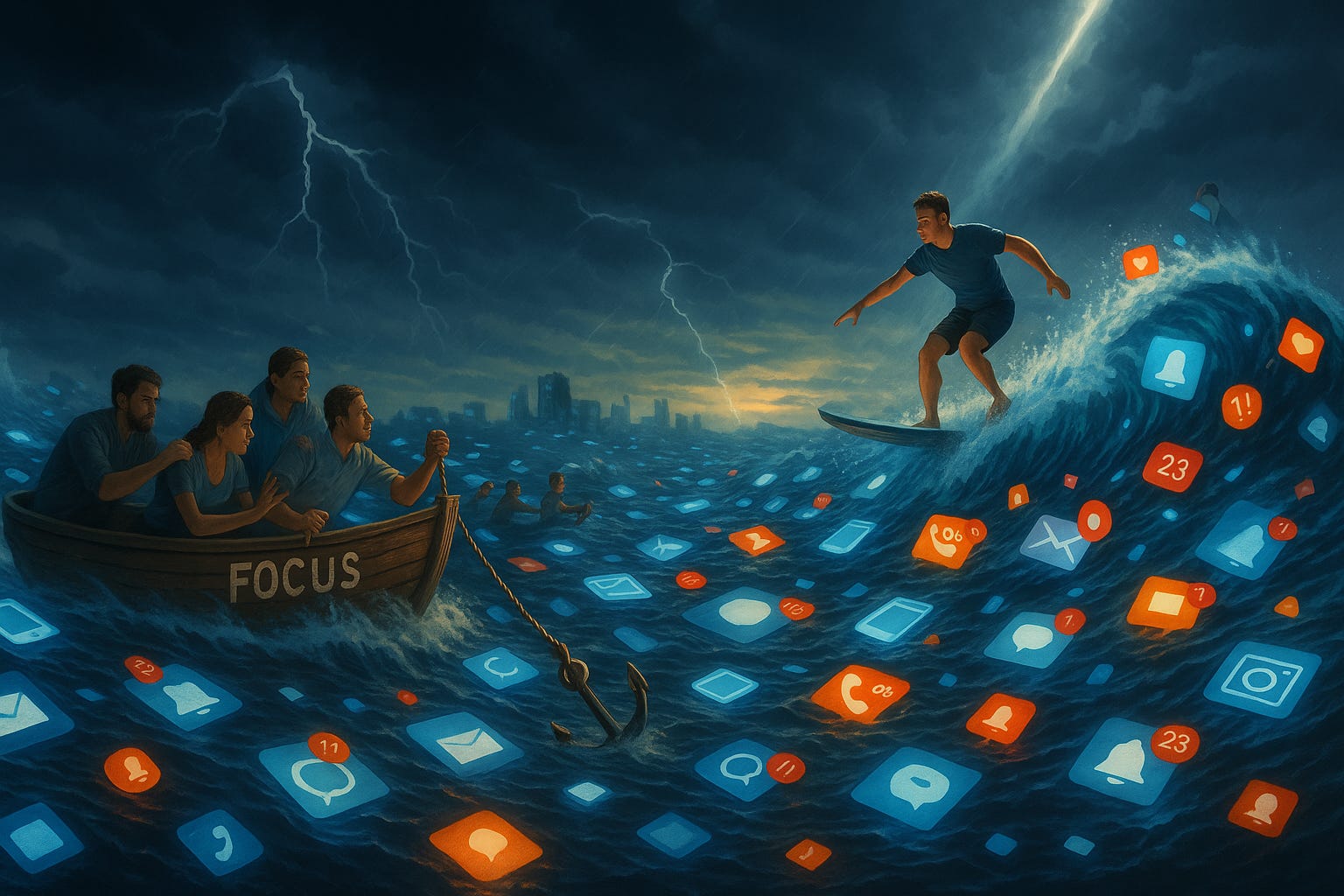
That’s not an exaggeration. It’s a crisis. And it raises a question with no easy answer: do we fight to rebuild focus—or learn to surf the waves of distraction?
This space is built for people who care about the future—not just the shiny version, but the human one. If that sounds like you, consider upgrading to a paid subscription. You’ll be helping to keep independent thinking alive and unfiltered.
The Collapse of Attention
This isn’t alarmism. It’s measurable.
The average human attention span, according to some studies, has dropped from around 2–3 minutes per task in the early 2000s to less than 47 seconds today.
TikTok clips average 21 seconds. YouTube Shorts, 15–60. Instagram Reels, 30.
Long-form content struggles. Book reading is down, podcast completion rates fall off after minutes, and even movies now get second-screened.
We live in fragments.
What used to be normal—sitting for hours absorbed in deep work, flow, or play—now feels alien. Uncomfortable. Even scary.
And when we lose the ability to sustain attention, we lose more than productivity. We lose the capacity to think deeply, to innovate, and to create things that can’t be produced in short bursts.
Why Attention Still Matters
Here’s the paradox: short bursts are great for consumption, terrible for creation.
No one writes a novel in 30-second sprints.
No one invents a breakthrough between TikTok scrolls.
No one builds a company by only dabbling in Slack messages and email.
Mastery, innovation, and transformation—they all require extended focus. Hours of immersion. Long stretches of boredom, frustration, and persistence.
If attention collapses entirely, we risk losing not just productivity but civilization’s ability to move forward.
The Case for Turning the Ship Around
Some argue the answer is obvious: resist.
Reclaim your focus. Rebuild your attention span like a muscle.
Boredom Training: Don’t kill downtime with a screen. Let boredom do its job—fuel imagination.
Digital Minimalism: Strip away notifications, uninstall the attention thieves, and design your environment for focus.
Deep Work Rituals: Block out time for work that requires extended effort. No multitasking. No interruptions.
Silence as a Feature: Give your brain the recovery it needs. Go for walks without headphones. Drive without podcasts. Let your thoughts wander.
This is the “turn the ship” approach: attention is sinking, so fight to stay afloat. Train yourself—and maybe a culture—to value depth again.
The Case for Surfing the Waves
But here’s the counterpoint: what if distraction is the new baseline?
Maybe our brains are simply adapting to the environment we’ve built. Instead of fighting it, maybe we should embrace it.
Micro-Creativity: Instead of forcing yourself into 3-hour blocks, create in 15-minute sprints. Stack the sprints.
Modular Work: Break big projects into atomic units. Write paragraphs, not chapters. Code functions, not systems.
Iterative Publishing: Ship faster, smaller, and rougher. Don’t wait for the “perfect” draft. Build in public.
Leverage Tools: AI can help stitch together the fragments—taking bursts of thought and turning them into cohesive wholes.
This is surfing the waves: accept shorter attention spans and design systems to ride them, not fight them.
Futurecasting: A Split World
The truth is, both approaches will coexist.
The Focus Elite. A small subset of people will deliberately train their attention like athletes. They’ll dominate fields that require depth: science, art, philosophy, and engineering. They’ll produce the breakthroughs.
The Attention Surfers. The majority will adapt to distraction and excel at rapid creation, remixing, and cultural relevance. They’ll dominate virality, entertainment, and short-form influence.
Both groups will matter. Both will thrive in different arenas. But the gap between them will widen.
Where AI Fits In
AI complicates everything.
On one hand, it accelerates distraction. Infinite feeds of AI-generated content will only fragment attention further.
On the other, AI could become the tool that reassembles fragments into coherence. Imagine:
You jot short notes across the day, and AI stitches them into a book chapter.
You record random thoughts in 30-second bursts, and AI turns them into a podcast script.
You consume information in short clips, and AI organizes it into long-form understanding.
AI may become the bridge between collapsing attention spans and the need for extended creation.
The Choice Ahead
So what should you do?
You can’t escape the attention collapse. But you can decide how to respond:
Train for Depth. Build the muscle of focus. Resist distraction. Carve out time for immersion.
Adapt for Breadth. Accept short bursts. Build systems to turn fragments into finished work.
Blend Both. Use short bursts to generate ideas, long sessions to assemble them. Use AI as glue.
The point is not to moralize. The point is to choose—consciously—how you’ll navigate the collapse.
Attention Is Contested Territory
Attention isn’t gone. It’s contested.
Platforms want to mine it. Algorithms want to fracture it. Distractions want to steal it.
But you still own the choice: rebuild it, adapt to it, or fuse both approaches into something new.
Because the future won’t belong to those who complain about distraction. It’ll belong to those who master it—whether by resisting or riding the waves.
I liked this very much and it is true that people's attention is getting shorter and becoming also insufferable because of it becuase of the lack of time peole give to each other now ( in certain situations, respectfully)
I think we can turn the tide. I believe so.
Keep up the great work.
An important factor not mentioned here is that the collapse is being caused intentionally. So to not resist it is to acquiesce to others' mental manipulations. Surely, that's always a bad idea.