

AI Will Create Better Humans
Not by replacing us, but by raising what we’re capable of

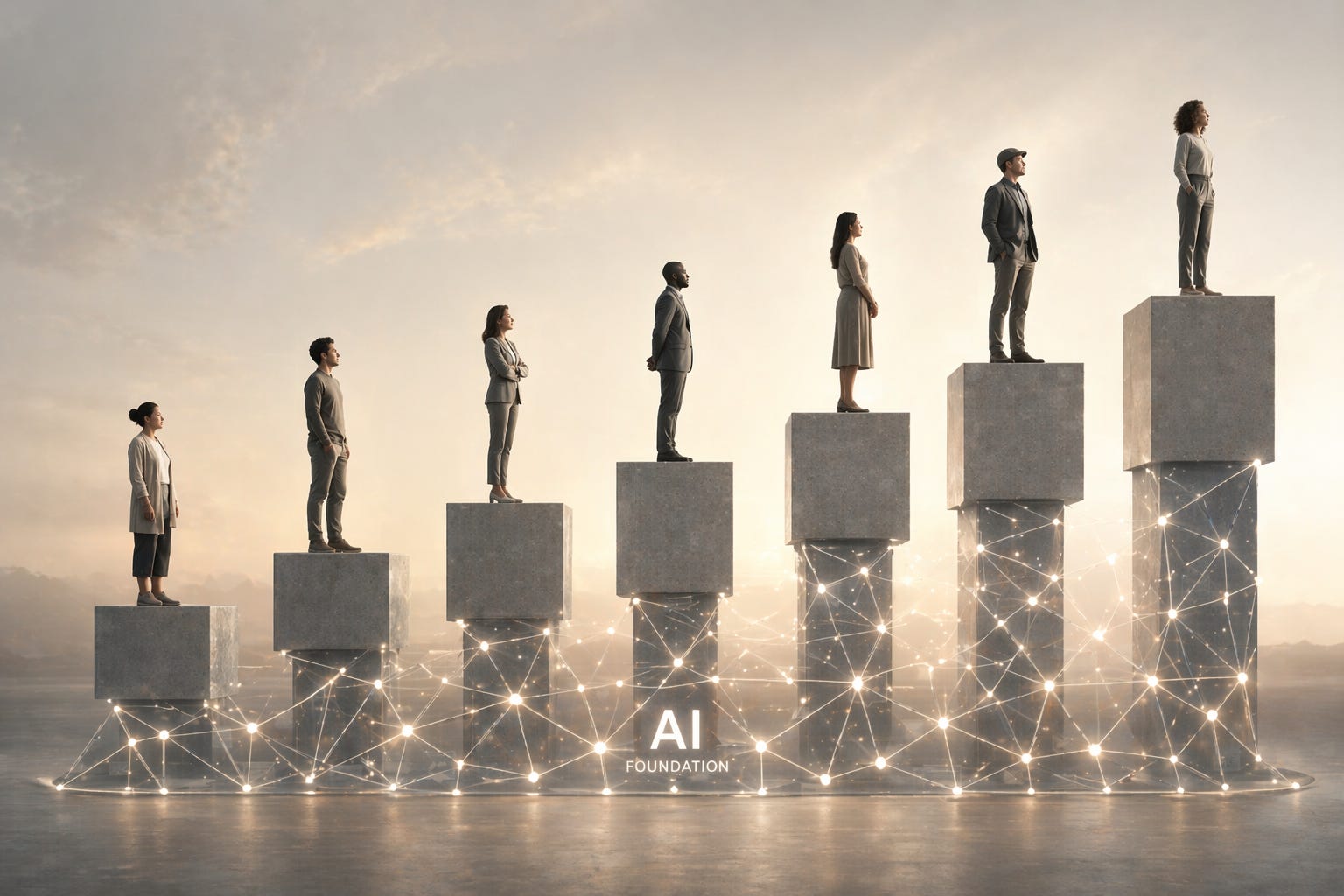
Most conversations about AI start with a flawed assumption: that intelligence is a zero-sum game.
If machines get better, humans must get worse.
If AI can do more, people must do less.
That framing feels intuitive, but it ignores how tools have historically changed us. Technology rarely replaces human capability outright. Instead, it reshapes where that capability matters.
Writing didn’t make us forget how to think; it changed how we store and process ideas. Calculators didn’t eliminate math; they shifted focus toward problem-solving. The internet didn’t remove knowledge; it expanded access and forced us to get better at filtering.
AI fits into this pattern, but at a much larger scale.
This space is built for people who care about the future—not just the shiny version, but the human one. If that sounds like you, consider upgrading to a paid subscription. You’ll be helping to keep independent thinking alive and unfiltered.
The Baseline Is Moving
What makes AI different is how quickly it distributes capability.
Tasks that once required specialized training—writing structured content, summarizing complex material, generating code—are now accessible to almost anyone. These skills don’t disappear, but they stop being scarce. And once something is no longer scarce, it stops being a reliable advantage.
This is the core shift.
AI raises the baseline of what individuals can do on their own. The average level of output increases, not because everyone suddenly becomes an expert, but because the floor has been lifted.
That changes how people differentiate.
From Doing to Deciding
As execution becomes easier, the bottleneck moves.
It’s no longer about whether you can produce something. It’s about whether you can decide what is worth producing.
AI can generate options quickly. It can draft, suggest, and iterate. But it does not decide which direction matters or which problem is worth solving. That requires judgment.
Knowing how to write still matters. Knowing what to write matters more.
Knowing how to build still matters. Knowing what to build becomes decisive.
The value shifts upward.
Less Friction, More Action
Another effect of AI is that it reduces the gap between idea and output.
You no longer need to start from a blank page. You can test ideas quickly, explore alternatives, and iterate with very little upfront cost. This changes behavior in subtle but important ways.
People act more when the cost of acting is lower.
Instead of waiting until something is fully formed, they experiment. They generate drafts, refine them, and move forward. That increase in iteration is not just about speed; it improves decision-making over time.
You learn faster when you can try more things.
The Confidence Shift
There’s also a psychological component.
A lot of people don’t act because they doubt their ability to execute. They have ideas, but no clear way to translate them into something tangible. AI lowers that barrier.
It doesn’t guarantee quality, but it provides a starting point. And that’s often enough.
When more people can move from idea to output, participation expands. More voices enter the system. More perspectives get expressed. That alone increases the range of what gets created.
The Risk of Sameness
Of course, raising the baseline introduces new problems.
If everyone uses the same tools in the same way, outputs begin to converge. You start to see similar structures, similar phrasing, similar ideas repeated across different contexts. This is already visible in AI-assisted content.
The risk is not that creativity disappears. It’s that differentiation becomes harder.
When the average gets better, standing out requires more than competence. It requires perspective.
Where Humans Still Matter
AI is good at producing answers that fit established patterns. It reflects what has already been said, learned, and repeated.
It is less reliable when something genuinely new is required.
Humans still matter in areas where patterns are incomplete or unclear. Context, taste, experience, and values all play a role in shaping decisions. AI can inform those decisions, but it does not own them.
Two people using the same AI system can arrive at very different outcomes. The difference is not the tool. It’s how they think.
The Real Shift
AI is not primarily a replacement technology. It’s a distribution mechanism for capability.
It takes skills that were once limited to specialists and makes them broadly available. That changes the structure of competition. Instead of competing on execution alone, people compete on interpretation and direction.
This is why the idea that AI will make humans “worse” misses the point.
It will make average execution better.
It will make access to capability more equal.
It will force differentiation to move to a higher level.
What “Better Humans” Means
When we say AI will create better humans, it doesn’t mean people will become perfect or universally more skilled.
It means more people will be able to operate at a higher baseline.
They will be able to test ideas more easily.
They will be able to learn more interactively.
They will be able to act with less friction.
What they do with that capability is still up to them.
AI doesn’t guarantee better outcomes. It creates the conditions where better outcomes are easier to reach.
The Constraint That Remains
The limiting factor doesn’t disappear.
It shifts.
Execution becomes easier. Responsibility becomes more important.
When more people can act, more people influence outcomes. That increases the importance of judgment. It increases the impact of decisions.
Better tools expand possibility. They don’t determine direction.
Be Better Humans
AI is not setting the ceiling for human capability.
It’s raising the floor.
Once the floor rises, more people can reach levels that were previously difficult to access. The difference between individuals will come less from what they can do and more from how they choose to use it.
That is where the real change happens.
This space is built for people who care about the future—not just the shiny version, but the human one. If that sounds like you, consider upgrading to a paid subscription. You’ll be helping to keep independent thinking alive and unfiltered.
AI is cool, but what if you could actually use it as your life coach?
That’s what 10xYOU is all about—turning AI into extra income, more focus, and healthier habits. It’s like thinkfuture’s practical twin—same curiosity, but built for action.
Check out our 10xYOU publications:

Money Monday with Ben Caldwell: Your AI Money Coach
Start your week with smart, stress-free money moves. Every Monday, Ben shares one actionable way to use AI to save, earn, or invest better. No fluff, no jargon—just practical steps you can use right away to make your money work harder for you.
Workflow Wednesday with Nik Harper: Your AI Productivity Coach
Every Wednesday, Nik shows you how to work smarter, not harder. From AI-powered tricks to practical workflow shifts, she’ll help you save time, cut stress, and actually enjoy your week. Quick reads, easy experiments, real results.
Fulfilment Friday with Leo Serrano: Your AI Wellness Coach
Fridays aren’t just the end of the week—they’re a reset. In Fulfillment Friday, Leo blends espresso-fueled storytelling, Nonna’s wisdom, and AI guidance to help you recharge and find balance. Each issue delivers a personal story, practical wellness strategies, and one simple “Friday Reset” challenge you can actually use before Monday.
You make it sound exciting, innovative with an aim to perhaps break a glass ceiling. not replacement but more like walking in lockstep with technology. So many fearscapes and witch-hunting going on with A.I it is nice to see another positive article about it, what it can do, what is possible and what can be achieved.
Great essay. Interestingly, I think lowering the cost of starting can absolutely change behavior for the better, but it can also come with lowering the cost of finishing.
It’s a tradeoff. When drafts come this easily, we may be less likely to reach out to colleagues early. Once something coherent is already on the page, the instinct (or need) to reach out and ask, “What do you think?” can disappear.
And sometimes that back-and-forth, which we might now call friction, is where the best thinking happens, while ideas are still rough enough to be changed.
I wrote recently about how A Day in the Life came together that way. John had an idea and, rather than rushing to a final draft, brought it to Paul, who had a completely different idea. Together they made something magical. And, pardon my strong bias, we’re all the better for it.